For signal providers
Calls backed by a broker fill, resolved in public.
Post a call from a position your broker already recorded, with its entry, stop and target, and a stamp saying how long after the entry it went out. A buyer sees the losses as well as the wins, under a seal nobody can award themselves.
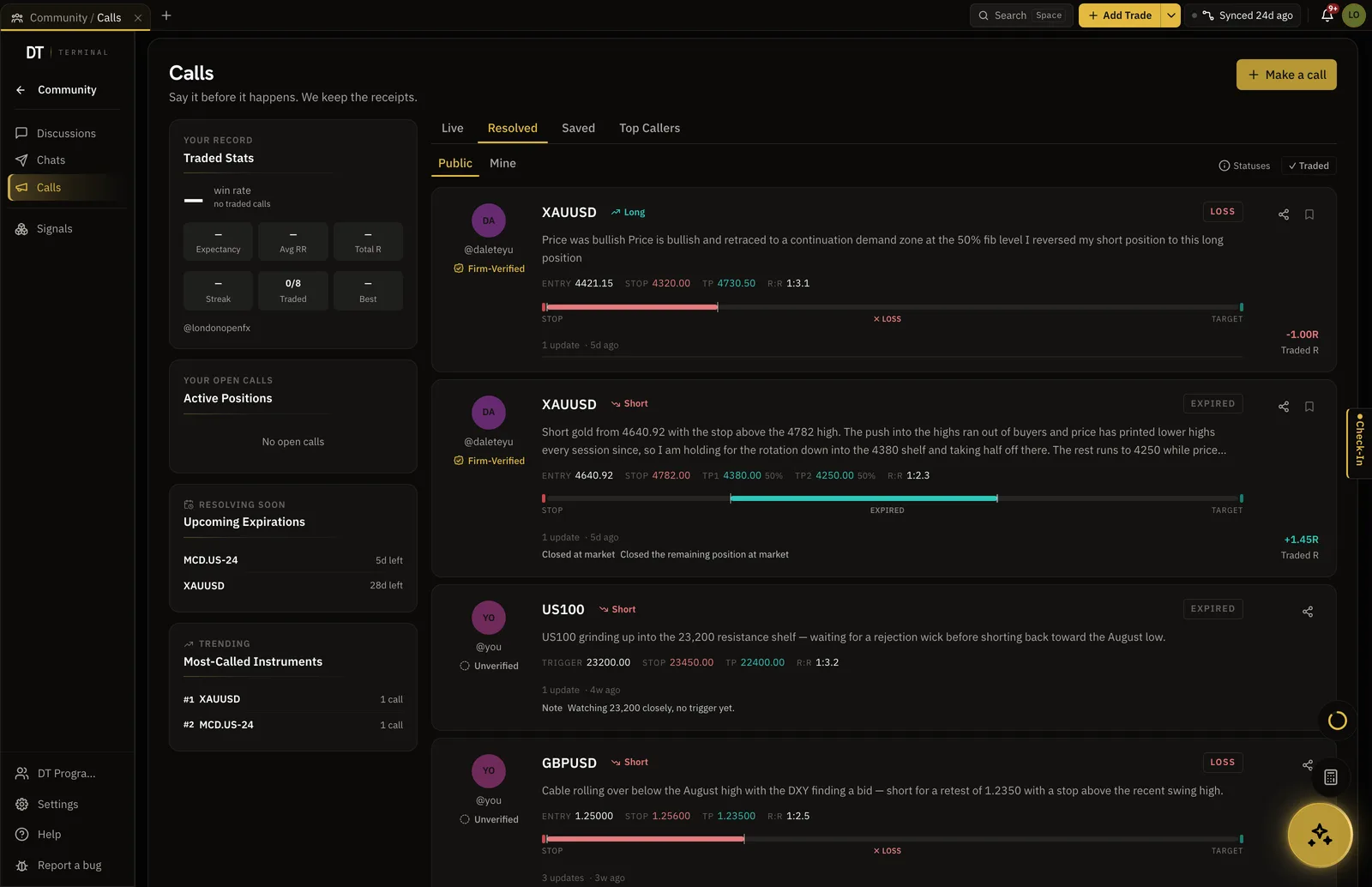
- Broker-Verified
- The badge a synced call carries
- Win, Loss, Expired
- How a call settles, on its own
- 148
- Brokers and exchanges you can pick by name
- Read-only
- Every connection, never trading
How a call becomes proof
- 01
Connect the broker
Read-only, on Pro. MT4, MT5, cTrader, TradeLocker and the crypto exchanges connect today. DT Terminal can see fills and balances and can never place, change or close a trade.
- 02
Disclose the call
From a synced position that is still open, with its instrument, direction, entry, stop and target. One setup held in several accounts posts as one call backed by every leg.
- 03
The market settles it
Win, Loss or Expired, on its own, and all three count toward your record. Pull a call before its entry triggers and it reads Invalidated, and never counts.
- 04
The record carries it
Switch public calls on and your call record publishes in R. The broker record is its own page, a DT Passport, so a buyer checks both instead of taking your word for either.
The call
A forecast that cannot be edited into a win.
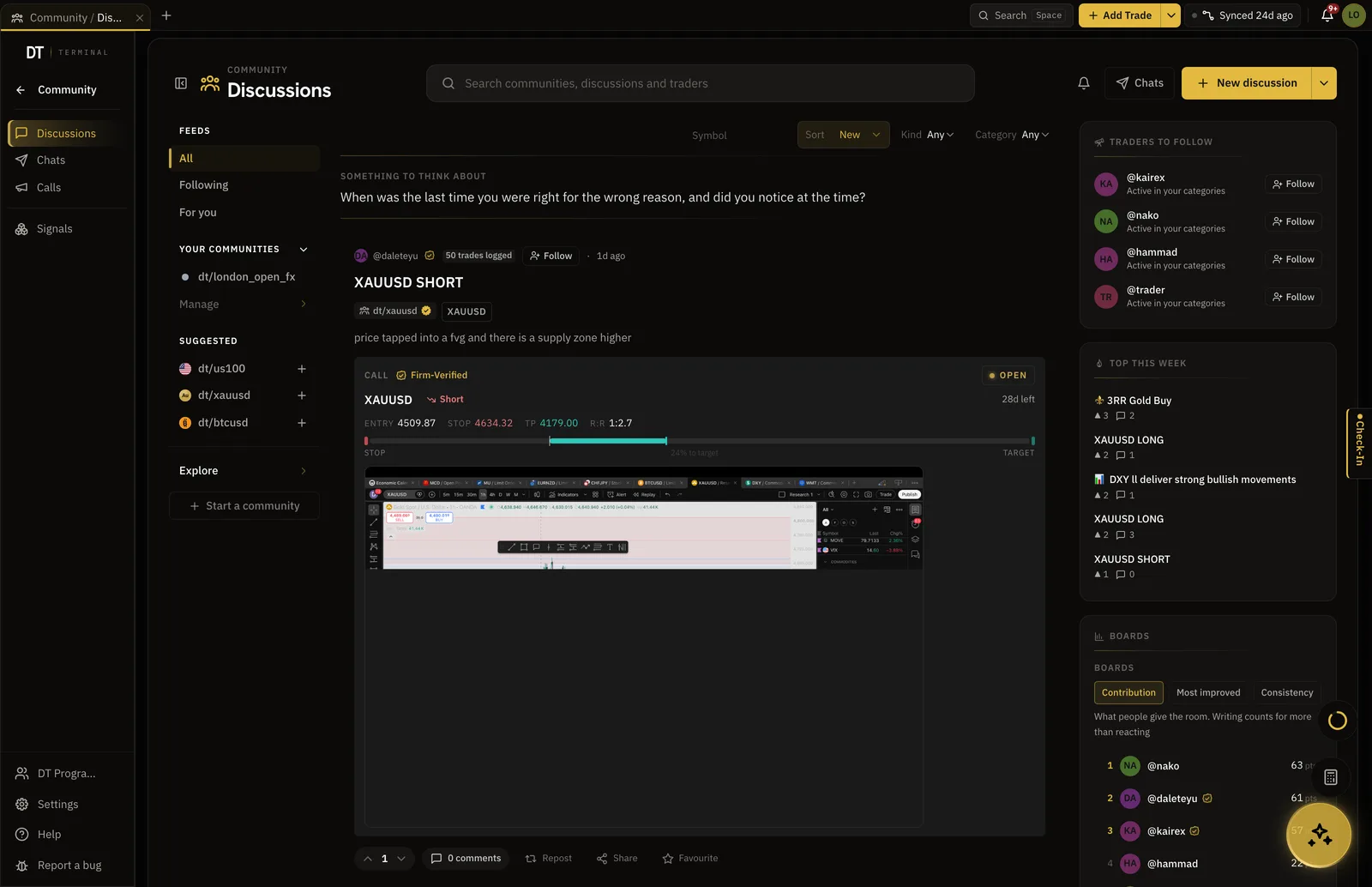
A call is a structured post, not a screenshot: instrument, direction, entry, stop, target and a clock. Disclose it from a broker-synced position and the card stamps how long after the entry it went out, in words, always on the card and never behind a hover.
- Entry, stop, target and a clock on every call
- Stamped with how long after the entry it was called
- Losses and expiries resolve as publicly as wins
- Stop moves and partial closes kept in the trail
The evidence
Let a buyer open the trade behind it.
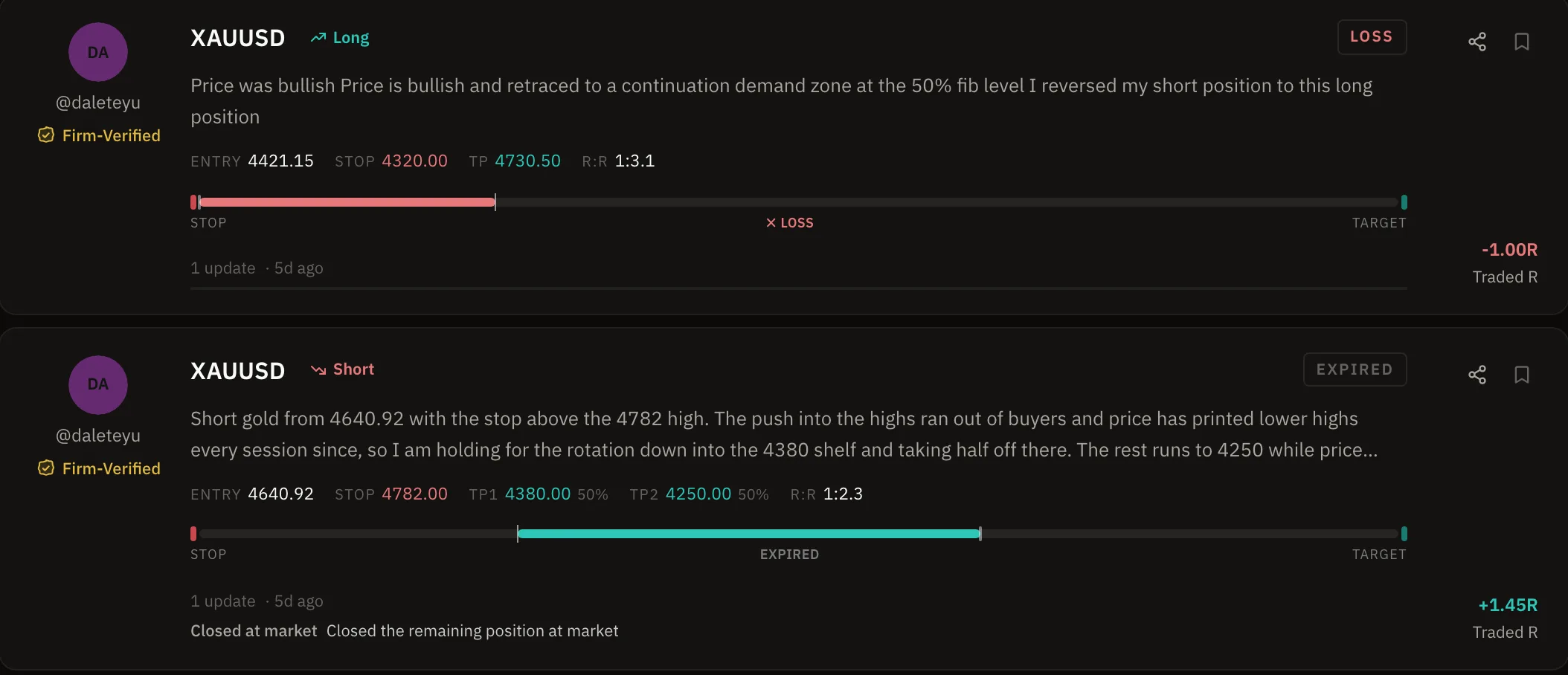
Every card carries a "The trade behind this" disclosure. You pick what it holds, field by field, from a fixed list: the broker facts are on by default and the money-shaped and free-text ones are off, so you can publish the fill without publishing your balance.
- Symbol, direction, entry, exit, stop and target on by default
- P&L, position size and your notes off by default
- Risk publishes as a percent; the money amount is yours to opt into
The record
A page a subscriber can check before they pay.
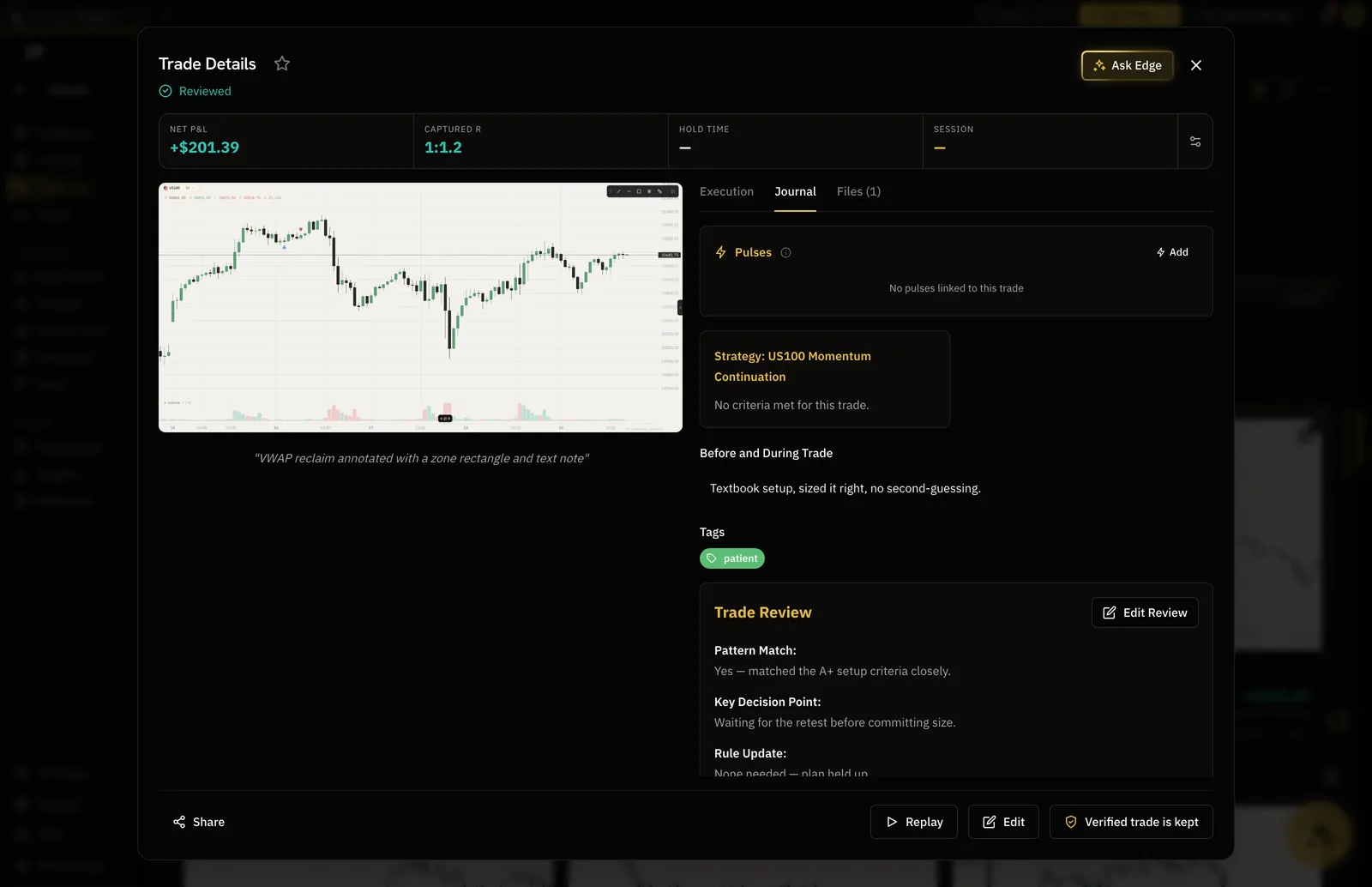
Claim a handle and your DT Passport publishes by default: a record read from the account rather than typed, carrying a Broker-Verified seal, or Firm-Verified on a prop account. Backtest and forward-test accounts can never be published on it, whatever the switch says, and that rule is the reason the seal means anything.
- Read from the broker, not typed and not uploaded
- Practice and backtest accounts never publish
- Own capital and firm capital kept in separate lanes
The room
Somewhere to post that is not a chat log.
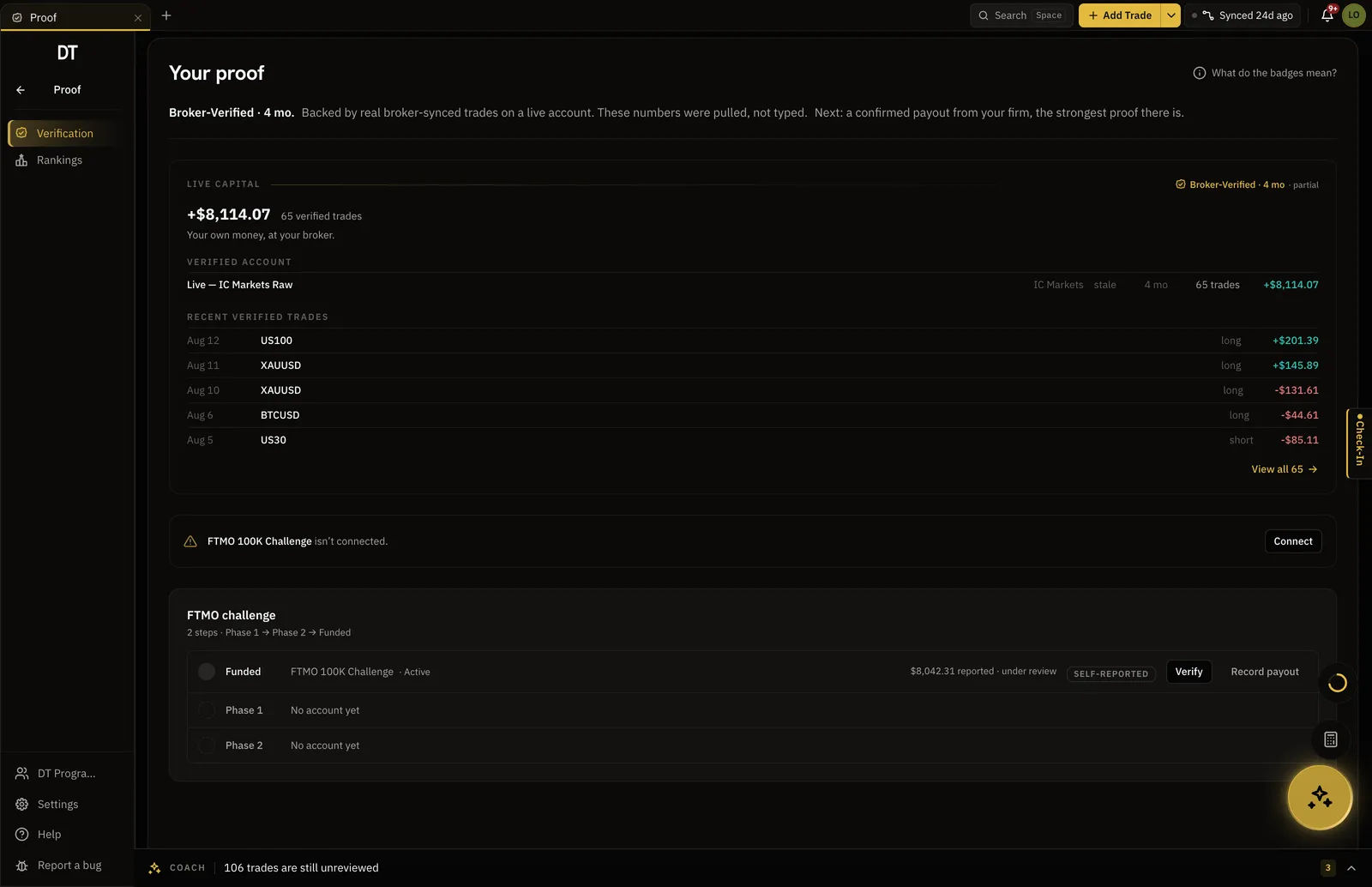
Your group keeps its home wherever it lives. The room is where the calls land, where anyone can read them without an account, and where a seal we mint tells a reader your room from an account that borrowed your name.
- Seal on the room, minted by us
- Public to read, gated to post
- Official updates posted through a link with no login
Read this first
What this is not.
There is no self-serve room: we provision one or mint a single-use invite, so the seal keeps meaning something. Nothing here advertises results or rates a service, and there is nowhere to state one. A call typed by hand rather than disclosed from a synced position reads Unverified and carries no seal. Futures platform sync is not live, so NinjaTrader and Tradovate accounts cannot be connected yet.
Questions
What does it mean for a call to resolve?
It settles against the market on its own, as Win, Loss or Expired, and all three count toward your record. Expired means it ended without a result: the entry never triggered, or the deadline passed with nothing banked. A call you pull before its entry triggers reads Invalidated and never counts, and one retracted within five minutes of posting is voided and never appears on the public board at all.
What is the badge on a call?
Broker-Verified means the call came from a trade on a synced live account, so the numbers were pulled rather than typed. On a prop firm account it reads Firm-Verified instead, because the capital is the firm's. A record where payout receipts have been reviewed by us reads Payout-Verified. The badge describes the account behind the call, never the caller in general.
Can a subscriber see the fill behind a call?
As much of it as you publish. Each card carries a "The trade behind this" disclosure, and what it holds comes from a fixed list you tick: symbol, direction, date, entry, exit, stop, target and strategy are on by default, while P&L, position size, your notes and your reflection are off. What a call risked always publishes as a percent of the accounts behind it; the money amount is a separate switch, off unless you turn it on.
What happens if I type a call by hand?
It posts, and it reads Unverified with the note "Self-reported". No seal, and the results boards count nothing but synced trades. That is the whole point: a caller who connects a broker is saying something a caller who types cannot say, and the page has to show the difference for either claim to be worth reading.
Do my subscribers need an account?
No. Calls and the public record are open to read with no login at all. A free account adds the running list: a reader can save up to 5 calls and follow up to 3 callers, and Pro lifts both caps.
What does this cost me?
Reading and posting calls are free, and reading needs no account. The broker connection, which is the thing that puts a badge on your calls and a seal on your record, is part of Pro at $18 a month or $149 a year. Your room costs nothing.
How do I get a room?
Through the support form. We open the room, hand you an invite for whoever runs it, and give you a posting link for official updates that needs no account. There is no self-serve route, deliberately: a seal anyone could award themselves would tell a reader nothing.
Can I run DT Terminal from Claude?
Soon. We are building an MCP connector that opens the whole of DT Terminal to Claude: every workspace and every piece of your data, to read and to act on, with your consent per scope. It works with any assistant that speaks MCP, and it is in development, not live yet.
Let the record make the claim.
Tell us who you are and we will open the room.
Your privacy choices
Essential storage keeps DT Terminal working, and we measure how the product is used on our own servers so we can see what needs fixing. That measurement is never shared and you can switch it off in your privacy choices. Optional, and off until you allow them: third-party analytics and 60-day referral attribution.