How to journal a prop firm challenge
By DT Terminal · Published · Prices checked 10 September 2026
Challenges are failed on rules far more often than on strategy, so a challenge journal has one job the rest of your journal does not: it tracks how much room you have left. Before the first trade, write down the two numbers that can end the account, the maximum daily loss and the maximum overall loss, and check whether your firm measures them on balance or on equity including open trades, and what time the day resets. Log every trade with its setup, its stop and target at entry, and the risk you took as a share of that day's remaining allowance. Review at the end of each session rather than the end of the phase. Connect the account read only so the record is verified rather than typed, and keep the funded account on the same record once you pass.
Who wrote this
DT Terminal is a trading verification platform that also makes a trading journal, so treat the screenshots as what our own tool does and the rules as what the firms publish. Every firm rule below was read on that firm's own help pages on the date above, and firms change them. Confirm your own programme's rules with your firm before you rely on any number here.
The two numbers
How four firms define the rules that end a challenge.
| Firm | Daily loss | Overall loss | Measured on |
|---|---|---|---|
| FTMO, 2 step | 5% of initial capital, resets 00:00 CE(S)T | 10% of initial capital, static | Equity, so open trades count |
| FundedNext, 2 step | 5% of initial balance, resets 00:00 server time | 10% of initial balance, static | Balance or equity, open trades count |
| The5ers, High Stakes | 5% from the previous day close, taken 00:00 UTC+3 | 10% of initial balance, absolute | Closing equity or balance |
| Topstep 50K | $1,000, optional in the Combine | $2,000 trailing on end of day balance, locks at the start balance | Net P&L, realised and unrealised |
Read on each firm's own help pages on the date above. Programmes differ inside the same firm, so check the one you bought.
The procedure
Seven parts, in the order they matter during a challenge. The first one is the only part that is urgent on day one.
01Know the two numbers that can end it
Almost every evaluation has a maximum daily loss and a maximum overall loss. The daily one ends more accounts, because it can be breached in an hour on a news release. Before you place a trade, write both numbers in your account, in currency rather than percent, so you are never doing arithmetic while a position is open.
Then answer two questions your firm has already answered on its own help pages. First, is the loss measured on your balance, or on your equity including open positions? FTMO measures the daily loss on equity, so a floating drawdown can breach it before you close anything. Second, when does the day reset? FTMO resets at midnight Central European time, FundedNext on its own server clock, The5ers at midnight UTC+3, and Topstep runs a trading day from 17:00 to 15:10 Central US time.
Whether the overall loss is static or trailing matters just as much. A static limit sits at a fixed level below your starting balance. A trailing one follows your highest balance up and never comes back down, which is why a good week can leave you with less room than you started with.
- Write both limits in currency, not percent, and keep them where you place trades
- Check whether floating profit and loss counts toward the daily figure
- Check the reset hour in your own timezone, not the firm's
What our own tracker does, and does not do
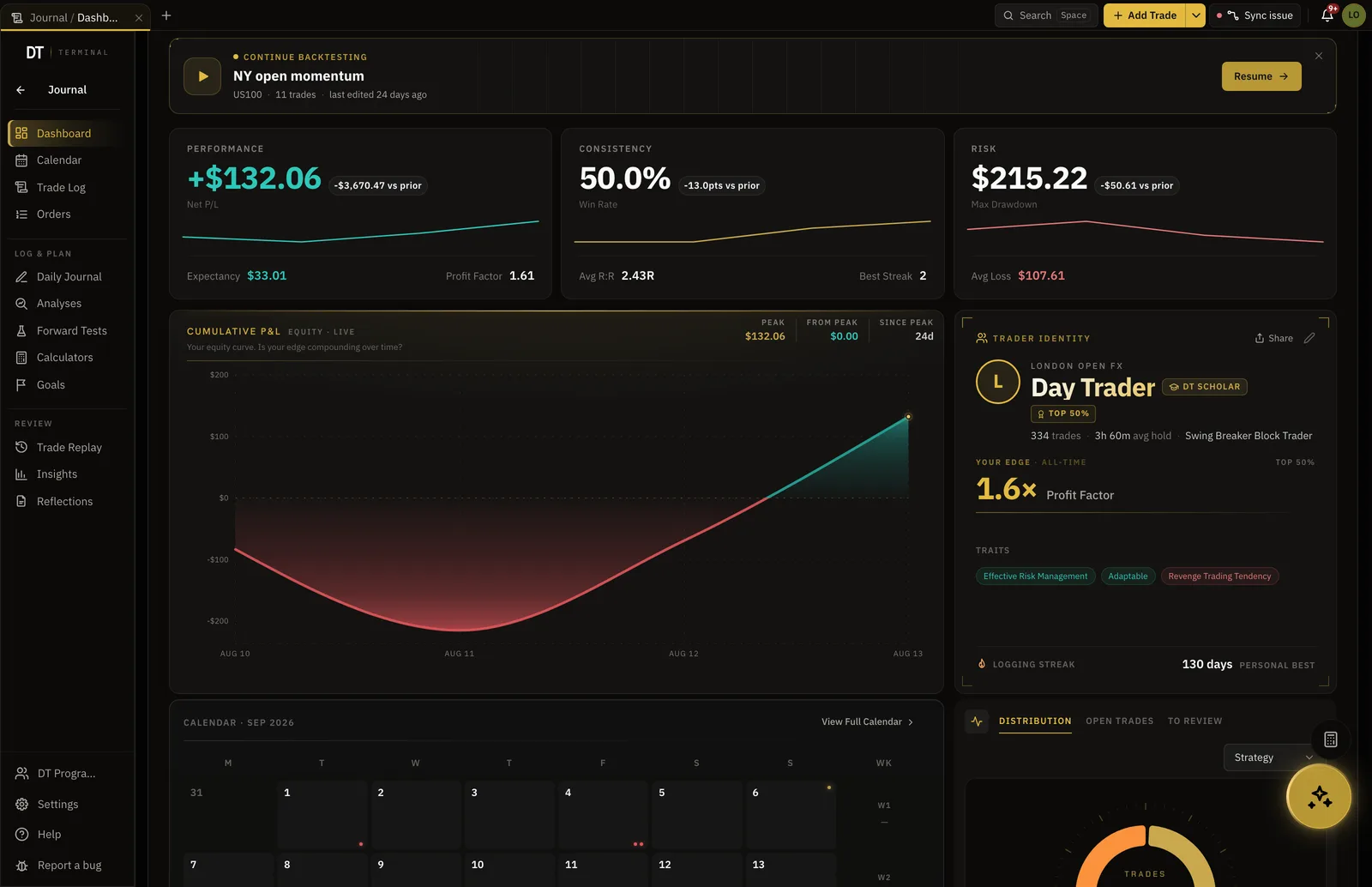
In DT Terminal you give an account its firm's limits and a rules card shows how close you are. That card follows your account balance and its daily figure resets at UTC midnight. If your firm counts floating equity or resets on another clock, the card is an early warning rather than the firm's number, and the firm's dashboard is still the one that decides.
02Set the account up before the first trade
A challenge is not the same book as your live trading, and averaging the two answers neither question. Give the evaluation its own account with the type set to the phase you are on, its starting balance, and the fee you paid for it, so a pass nets out properly against what it cost you.
In DT Terminal, choosing a known firm and programme fills in the phase ladder, the profit target and the limits. Editing any of those tells the account it no longer follows that programme, which is the honest outcome: an edited rule set is your own. Phases run as a chain, so passing one keeps its history instead of overwriting it.
- One account per phase, with the purchase cost recorded on it
- Set the profit target and any minimum trading days beside the loss limits
- Keep a separate account for forward tests, so practice never lands in the challenge numbers
03Log every trade the same way
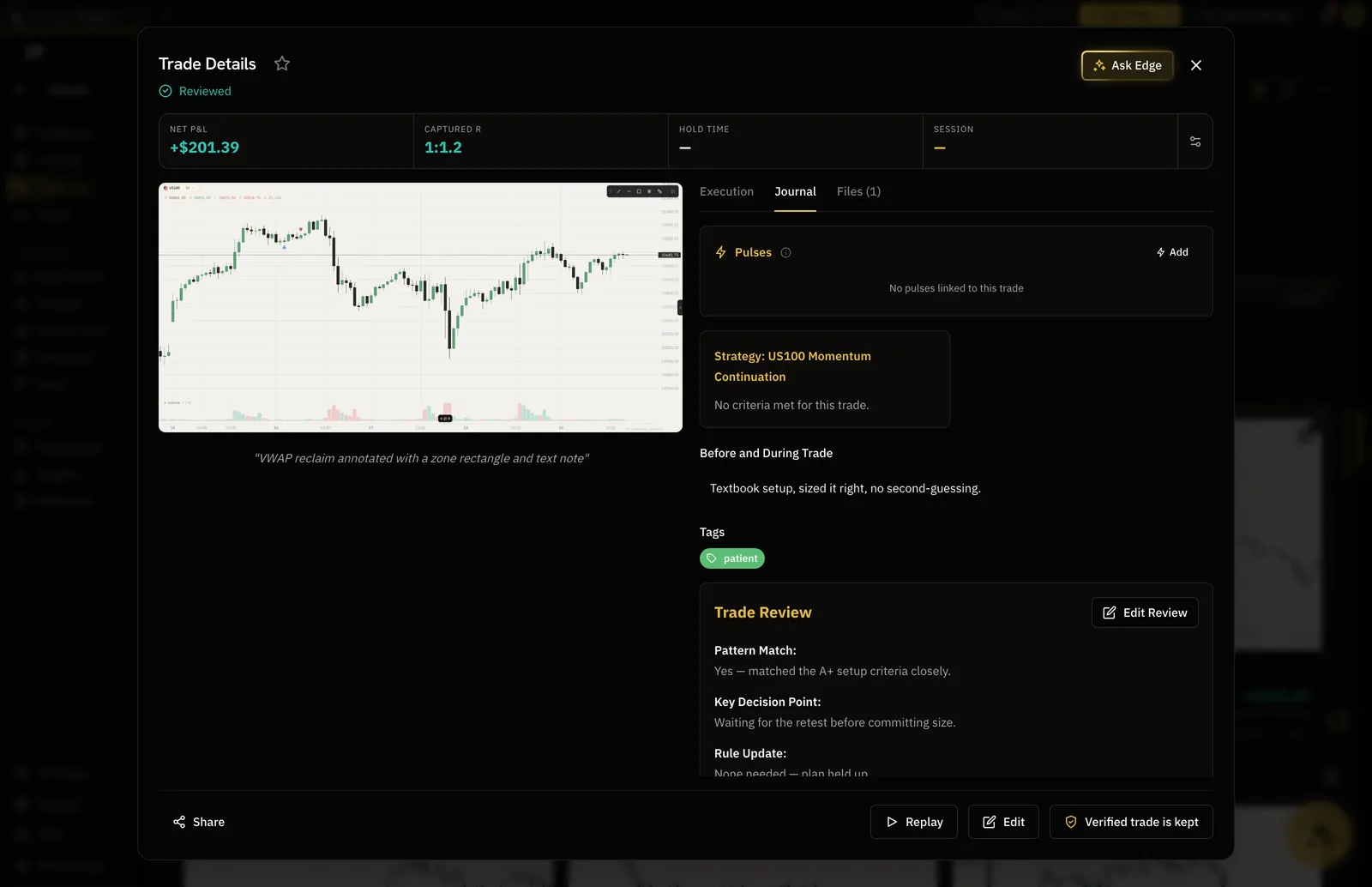
A challenge journal is only useful if the entries are comparable. Fix the fields on day one and fill the same ones every time: the setup or strategy, why you took it, the stop and the target as they were at entry, and the size as a share of the daily allowance you had left at that moment. That last field is the one most journals miss, and it is the one that explains a breach afterwards.
Note the stop you actually set, not the one you meant to set. If you moved it, the journal should show both, because a moved stop is the most common way a planned one percent loss becomes a four percent day.
- Setup, reason, stop, target and risk, every time, in the same fields
- Tag the mistakes you already know you make, so they can be counted later
- A free account holds unlimited trades with three tags on each
04Review at the end of the day, not the end of the phase
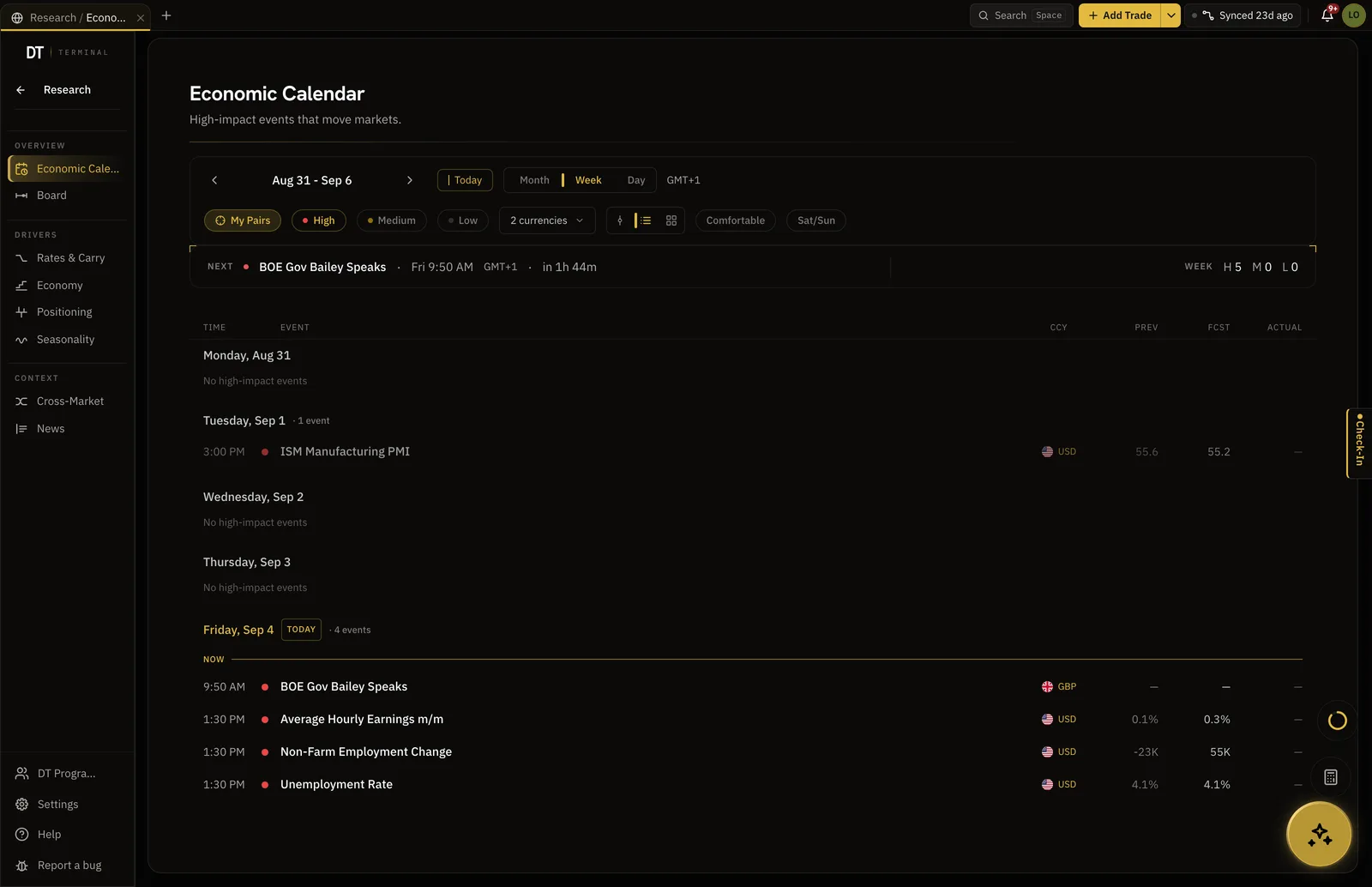
The review that saves a challenge is short and daily. How much of the daily allowance did you use? Did any trade breach the rule you set for yourself rather than the one the firm set? What is tomorrow's calendar, and is there a release that has ended a day like this before?
Doing this weekly is too late, because the account can be gone by Wednesday. A free account gives you three check-ins a day and three calendar alerts, which is enough to cover a session start and the two releases that matter.
- Measure the day against the allowance, not against your profit target
- Write the reason for a breach on the day it happened, while you remember it
- Set alerts for the releases that fall inside your session
05Sync the account so the record is not just typed
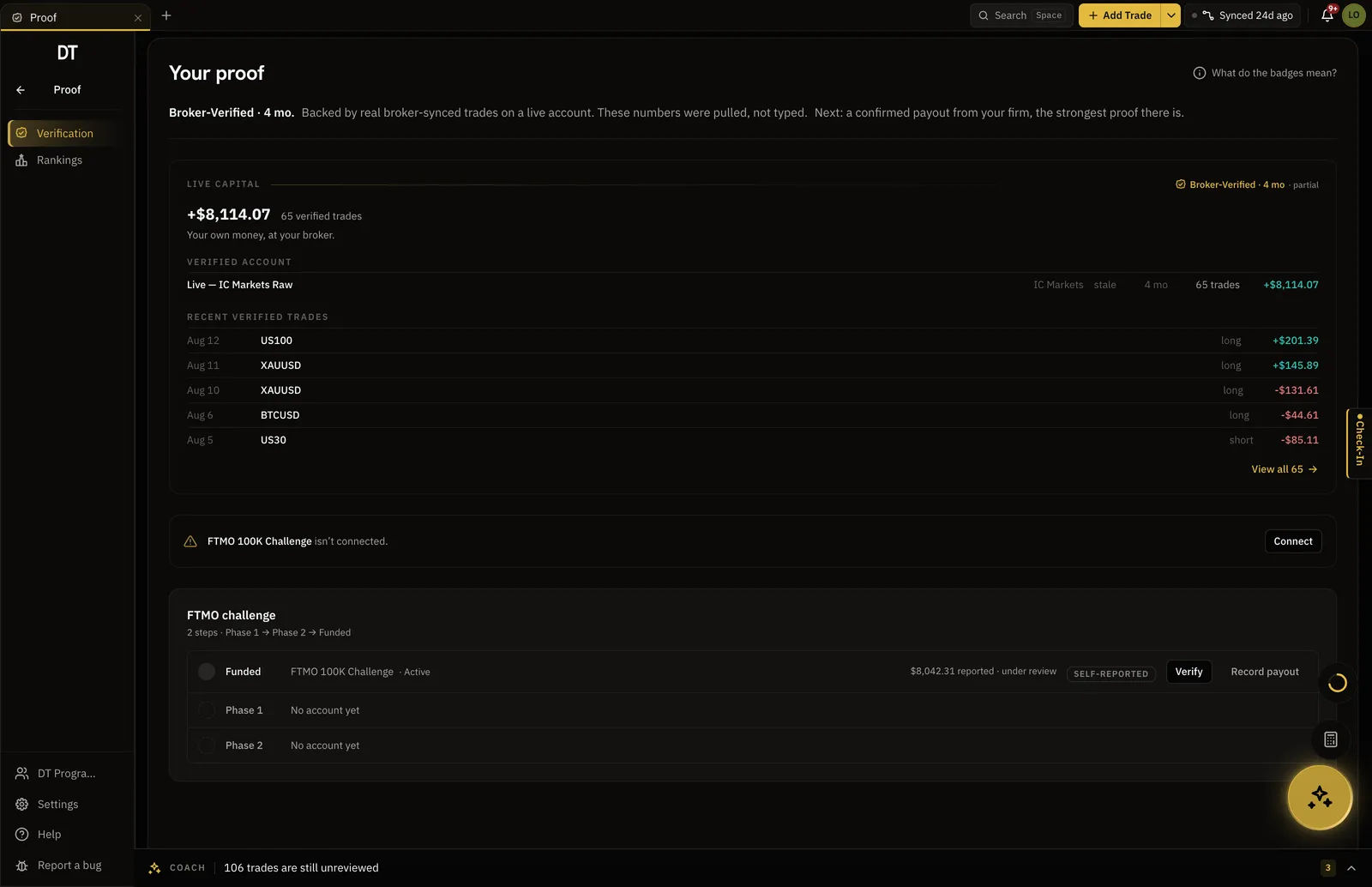
A typed record proves nothing to anyone but you. Connecting the account read only means the fills arrive on their own, which removes both the honesty question and the evening of data entry. In DT Terminal an MT4 or MT5 account connects with a read only investor login, cTrader and TradeLocker accounts connect too, and a prop account that syncs earns a Firm-Verified seal rather than the Broker-Verified one a live personal account gets. Both say the same thing: these numbers came from the platform, not from a keyboard.
Two gaps to be straight about. Futures platform sync is not live, so a Topstep, Tradovate or NinjaTrader challenge is imported from the platform's own CSV export today, and neither platform is connected yet: a NinjaTrader connection is being built. Stock broker sync is absent. Broker sync and verified trades are Pro features.
- MT4 and MT5 connect with a read only investor login, so nothing can trade the account
- A synced prop account reads Firm-Verified, a synced live account reads Broker-Verified
- One hand typed trade on a connected account is what costs a verified figure its meaning
06Keep the funded account on the same record
Passing is the start of the record that is worth something. A funded account that keeps syncing builds a track record with the strongest rung of proof available, a payout confirmed against the statement the firm issued, and it sits beside the evaluation that earned it rather than replacing it.
Publishing is opt in. Your record stays private until you claim a handle and choose to publish it, verified trades and hand logged trades are shown as what they are, and you can stop publishing later without touching the underlying trades.
- Verified trades are split into lanes, your own capital in one and prop accounts in the other
- A confirmed payout is the strongest rung, because the statement the firm issued shows it happened
- A public profile lives at a handle you claim, and it is opt in
07If the fee is the obstacle, the record can pay for it
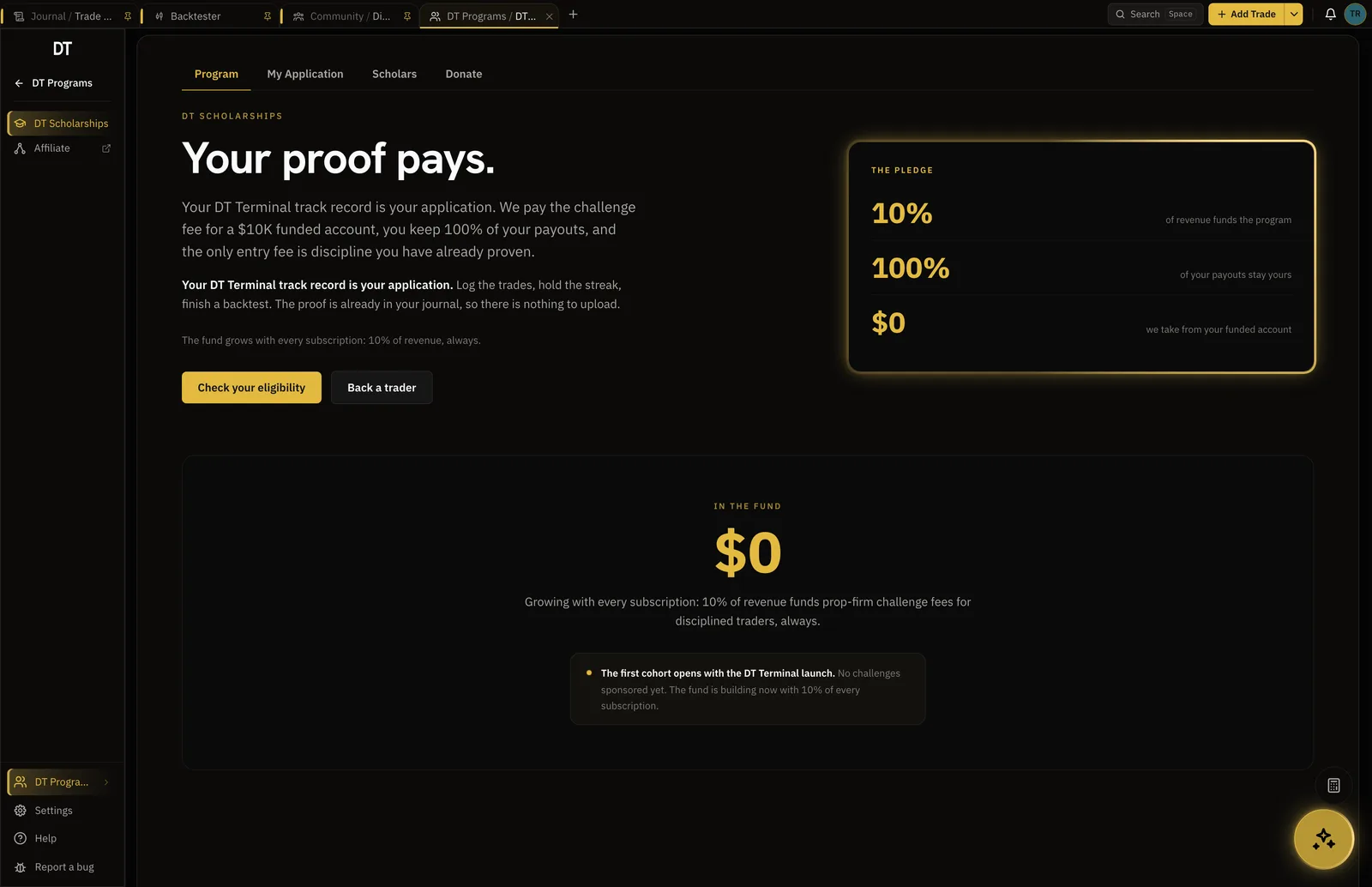
DT Scholarships pays the evaluation fee for a $10K challenge on behalf of traders who have shown they journal and review consistently. It is not a prop firm: 10% of DT Terminal revenue funds it, we pay the fee and step away, and 100% of your payouts stay yours.
The application is the record you have already been keeping: 10+ trades logged, 14-day logging streak, 1+ backtest completed, and an account in good standing. Forward tests count toward the trades. Applications are reviewed each cycle and chosen on merit rather than first come first served, and a declined application can be made again after 30 days.
- 10+ trades logged, forward tests count
- 14-day logging streak, reached at least once
- 1+ backtest completed, a reviewed session
Questions
What should I log on every trade during a challenge?
The setup or strategy, why you took it, the stop and target as they stood at entry, the size, and the risk as a share of the daily allowance you had left. Add a tag for any rule you broke. The last two fields are what explain a breach when you read the week back, and they are the ones most journals leave out.
How do I track the daily loss limit properly?
Convert it to currency before you trade, and check two things on your firm's own help pages: whether it is measured on balance or on equity including open positions, and what time it resets. FTMO measures on equity and resets at midnight Central European time. FundedNext resets on its server clock. Topstep runs its day from 17:00 to 15:10 Central US time. A tracker in any journal is an early warning, and the firm's dashboard is the number that counts.
What is the difference between static and trailing drawdown?
A static limit sits at a fixed level below your starting balance and never moves. A trailing limit follows your highest balance up and does not come back down, so profit raises the floor you can fall to. FTMO's 2 step maximum loss is static. Topstep's maximum loss trails on the end of day balance until it reaches the starting balance, then locks there. Which one you are on changes how a winning week should change your position size.
Does a prop firm account count as verified?
In DT Terminal a synced prop account earns a Firm-Verified seal, and a synced personal live account earns Broker-Verified. Both mean the trades came from the platform rather than being typed in. Prop challenges run on demo servers by design, so a blunt rule against demo accounts would exclude every funded trader; what matters is that the account is connected and the firm is recognised rather than declared.
Can I sync a futures prop account like Topstep or Tradovate?
Not yet. MT4 and MT5 accounts connect with a read only investor login today, cTrader and TradeLocker accounts connect too, and crypto exchanges connect by read only API key. Futures platform sync is not live: a NinjaTrader connection is being built and Tradovate is not connected. Until then a futures challenge is imported from the platform's CSV export, which still gets the trades into the journal but does not earn a verified seal.
How do I get a funded account without paying the fee?
DT Scholarships pays the evaluation fee for a $10K challenge for traders who meet three gates: 10+ trades logged, 14-day logging streak, 1+ backtest completed. Free entry competitions at some firms are the other honest route. Our guide to getting a funded account for free covers both, including which "free" offers are really discounts.